
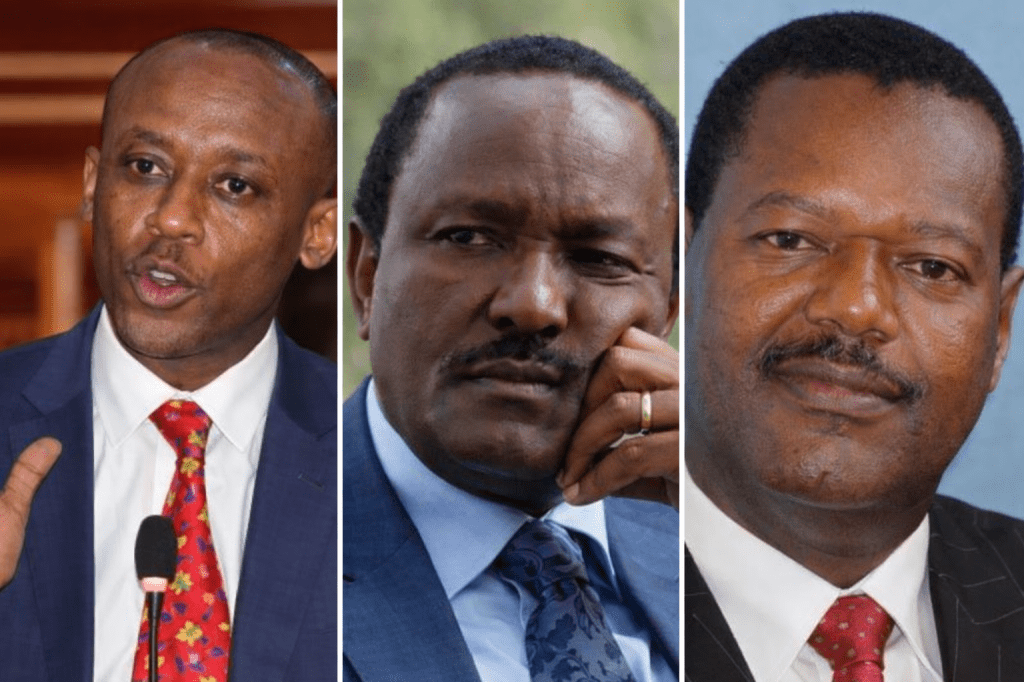
With Prof. Kaloki’s entry into Makueni politics, Mutula Kilonzo Jr. faces the most serious threat to his political survival yet. What once appeared as manageable political murmurs has now crystallised into a coherent and credible challenge one that exposes Mutula’s vulnerabilities more starkly than at any other point in his career.
A major inflection point has been Mutula’s recent public utterances regarding Kalonzo Musyoka’s national political ambitions. His remarks, widely interpreted as dismissive and condescending toward Kalonzo’s chances, unsettled a political base that still views Kalonzo as central to Makueni’s political identity and its bargaining power at the national level. In a county where symbolism, loyalty, and political lineage matter deeply, such comments risk alienating core supporters and influential party insiders.
Beyond rhetoric, Mutula is increasingly weighed down by questions of development delivery. Criticism over stalled or underperforming projects has grown louder, culminating in rare and pointed remarks by his predecessor, Governor Prof. Kivutha Kibwana. Kibwana openly accused the current administration of grounding or neglecting projects initiated during his tenure between 2013 and 2022 an extraordinary rebuke that lent institutional credibility to concerns long circulating at the grassroots. When criticism comes not from political rivals but from a respected predecessor, its impact is far more damaging.
It is within this context that Prof. Kaloki’s entry becomes particularly consequential. Kaloki is no political novice parachuted into relevance. His involvement in the fiercely contested 2022 Nairobi gubernatorial race established him as a strategic operator with experience in high-stakes mobilisation, messaging, and coalition-building. For many observers, this background makes him a formidable challenger one capable of translating dissatisfaction into structured, competitive political action.
Kaloki’s appeal also lies in contrast. Where Mutula increasingly carries the burden of incumbency fatigue, internal party tensions, and unmet expectations, Kaloki projects technocratic competence and political renewal. To voters frustrated by stalled development and perceived detachment from grassroots realities, this contrast is compelling. It reframes the contest from one of loyalty versus rebellion to one of continuity versus performance.
There is also a growing perception problem tied to political dynasty. As the son of the late Mutula Kilonzo Snr.a powerful senator and a prominent lawyer during the Moi era,Mutula Jr. is increasingly viewed by sections of the electorate as a beneficiary of inherited political privilege rather than earned political connection.
In a time of rising voter resentment toward dynastic politics, this perception risks deepening the disconnect between the governor and ordinary citizens struggling with everyday economic and service-delivery challenges.
Crucially, Mutula’s political survival may now hinge almost entirely on one factor: securing the Wiper Democratic Movement ticket in 2027.
Wiper remains the single most decisive political vehicle in Makueni. Without its backing, Mutula would be thrust into hostile electoral terrain where party machinery, grassroots networks, and historical loyalties may no longer align in his favour. Failure to clinch that ticket would leave his campaign dangerously exposed politically speaking, his goose would indeed be cooked.
This is no longer a theoretical threat. Prof. Kaloki’s entry has transformed discontent into possibility, whispers into organisation, and criticism into choice. Whether Mutula can arrest this momentum will depend not on rhetoric or inherited legacy, but on tangible delivery, party diplomacy, and political humility.
If he fails to adapt, the Kaloki factor may prove to be not just a challenge but the catalyst for a post-Mutula era in Makueni politics.
 NEWS & JOBS